
THE STEAL 013
Bellman & True (1987)

Every good heist movie begins with a plan.
Actually that’s not true. It’s complete bollocks. A lot of good heist movies begin with a plan.
If we listed the few that don’t - where characters with a certain skill set act completely on impulse - then it’s a much shorter list that quickly strays into straight-up crime movie territory.
Those crazy kids, BONNIE AND CLYDE (1967), rob plenty of banks, but do they ever really pull off a heist? You say tomato we say tommy-gun riddled corpses at the side of the road is what impulsive gets you.
Take our all-time favourite spur-of-the-moment bank robbery in OUT OF SIGHT (1998), where Clooney has a very bad day that ends with a flooded engine and another colourful jump suit.
So what we should have said is this: some of the best heist movies aren’t about the plan at all.
They’re about the stray variable.
Sometimes its a loose cannon on the crew like Waingro in HEAT (1995) or the knucklehead Matt Helm in ASSAULT ON A QUEEN (1967) who, with Sinatra as a partner and a U-boat full of loot, still can’t resist grabbing a dumb ring on his way out. Sometimes it’s an unexpected witness, the wrong bag of money or a car that just won’t start.
A random occurrence that nudges the story off its tracks and turns the competence porn we love into chaos. Suddenly the characters have to think on their feet or get blown out of their boots.
The robbery becomes background noise. The spiral becomes the plot.
Donald Sutherland made a few great heist movies, but in 1979’s A MAN, A WOMAN AND A BANK, it’s the literal plan itself that lands him in it. The perfect beginning to his job goes immediately off the rails when he walks out with a blueprint of the vault under his arm and a smile under his stolen hard-hat that lands him straight into the camera lens of Brooke Adams and front and centre on the the promotional material for the bank he was planning to rob incognito.
In CHARLEY VARRICK (1973), a small-town job goes smoothly, until the crew realise they’ve stolen Mafia money. Uh oh, SpaghettiOs. If you want to see how our perennial anti-saint of heists, Parker, handles that problem then check out THE OUTFIT (1973) and remind yourself why Robert Duval’s passing hit us so hard.
Any excuse to watch Joe Don Baker though, right?
THE ANDERSON TAPES (1971) shows Connery at the top of his game, except he has no idea that the real threat isn’t the caper but an entire building already wired for surveillance. While BEFORE THE DEVIL KNOWS YOU’RE DEAD (2007) pivots on a single should-have-seen-that-coming moment that turns calculation into tragedy.
Sometimes the plan works perfectly and that’s not enough.
It’s almost like there’s some bastard screenwriter up there determined to fuck it up for all of us.
Welcome to THE STEAL. Keep your head down.
Rob gets all gadgety and fatherly with 1987’s BELLMAN & TRUE
If you ever find yourself doing a pub quiz, and one of the questions is ‘Which two heist films of the 1980s prominently feature remote controlled ashtrays?’ then, first of all, please write in and let us know where this pub quiz is because it sounds great. And, secondly, you can be very smug because you read THE STEAL and you know that the answer is MALCOLM from 1986 and BELLMAN & TRUE from 1987.
Is it weird that two films, which came out within twelve months of each other, from opposite sides of the planet, featured semi-autonomous bank robbing butt bins? Well, not really, especially when you consider that the multiplexes of the 1980s were jam-packed with robots and gadgets of all shapes, sizes and degrees of psychopathy.
On the adult side of things you had TERMINATOR (1984) and ROBOCOP (1987), as well as BLADE RUNNER (1982) and ALIEN (1979) with Ian Holme’s Ash (both halves of him). While on the more family side of things, there was SHORT CIRCUIT’s Johnny Five (1986), D.A.R.Y.L. (the Data Automated Robotic Youth Life form from 1985), FLIGHT OF THE NAVIGATOR (1986), BATTERIES NOT INCLUDED (1987) and not forgetting Paulie’s Robot in ROCKY IV (1985) - who has a strangely touching backstory, which didn’t stop him being axed from the recent director’s cut of the film.
What makes BELLMAN & TRUE stand out is that it’s actually based on a novel written in 1975. So, from a technological standpoint it was pretty ahead of its time. The novel (blurbed as “Moving, affecting, exciting” by one John Le Carre) was written by Desmond Lowden, who started his career as a ‘rewind boy’ in the projection box of a Rank cinema, before going on to become a runner at Pinewood film studios, and then a full time writer of plays, screenplays and books (coincidentally Lowden worked on HELL DRIVERS (1957) directed by Cy Endfield and starring Stanley Baker - see issue 011 for more on what they did next).
Lowden does seem to have had a bit of a fascination with technology. As early as 1968 he wrote an episode for the BBC’s Thirty Minute Theatre called THE NEWS-BENDERS in which a brilliantly sinister Donald Pleasance surgically implants a transmitter inside a potential employee in order to eavesdrop on him.
N.B. Thanks to the Beeb’s habit of wiping their tapes, only three of the 286 episodes of Thirty Minute Theatre are available to see today. Luckily THE NEWS-BENDERS is one of them:
In BELLMAN & TRUE the gadgets are there because our main character (who we only know as Hiller) is a computer engineer who has fallen on tough times. His wife has left him, he’s hit the bottle and he’s been tempted by an offer to steal a spool of computer tape from his employer and hand it over to a proto-yuppie and gangster wannabe named Salto. Unfortunately Salto’s knowledge of binary isn’t great and he has to drag the reluctant Hiller back in to decode the ones and zeroes into something that will help him unlock the security system of a bank near Heathrow Airport.
Apart from the fact that he’s not really an underworld sort, Hiller’s reluctance mainly stems from the fact that he’s been left in sole care of his stepson whose name we never learn and who is referred to throughout the film as The Boy (of course, it almost goes without saying that The Boy is going to get dragged into this mess, and the gang are going to need Hiller for a lot more than just decoding bytes).
A lot of crime films will introduce some kind of parent-offspring relationship as a quick way of shoehorning in a bit of emotion and jeopardy (‘I’ll do whatever you want! Just don’t harm the child!” etc), and in less skilled hands, BELLMAN & TRUE could definitely have gone that way. But, luckily, the producer on B&T was the BBC’s Michael Wearing, who saw the father-son relationship as the “poetic, elemental, love story” at the heart of a “redemption story”.
Richard Loncraine (a fellow gadget obsessive, whose previous jobs had included directing items for Tomorrow's World) was brought on to direct the film, and he and Wearing immediately decided to cast Bernard Hill as Hiller. A no-brainer decision as Wearing had been a producer on Alan Bleasdale’s brilliant BOYS FROM THE BLACKSTUFF, in which Hill had made his name as Yosser Hughes.
For the role of the stepson, Wearing and Loncraine toured the north, auditioning over 300 kids from Liverpool and Manchester before landing on Kieran O’Brien. If you grew up in the 80s then you’ll know O’Brien as the star of the series, GRUEY. And if you didn’t grow up in the 80s then you might know him as the star of Michael Winterbottom’s 9 SONGS (2004), a film which cemented his place as “the only mainstream British actor who has been shown ejaculating in a mainstream UK-produced feature.” (he was also in ANDOR, TED LASSO and CHERNOBYL along with a ton of other things).
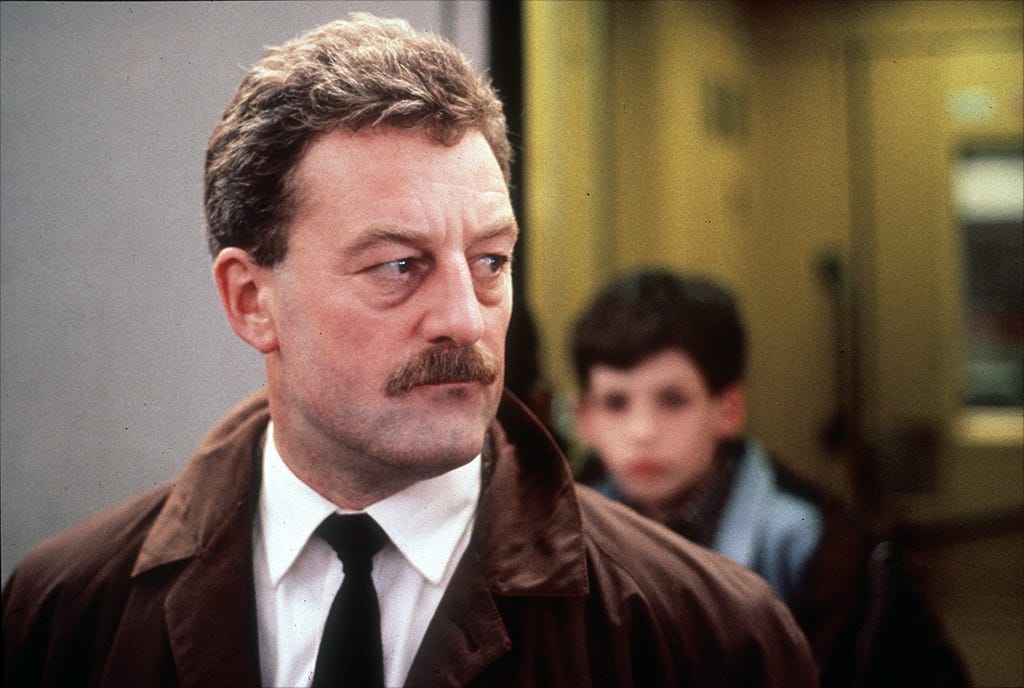
With talents like Hill and O’Brien at its heart, and Loncraine looking to bring an arthouse feel to the slightly pulpy source material (the director wanted to shoot the whole thing in black and white but wasn’t allowed, so opted instead for what he called a ‘van Eyck wash’ in the style of the Flemish painter), it’s no surprise that BELLMAN & TRUE didn’t turn out as just another run-of-the-mill London bank job flick. Instead what we get is a really quite beautiful and complex film that manages to be poetic and ugly, childlike and grown up, and comic and tragic, all within the space of 112 minutes.
Even though it was made in the late 80s, the film manages to capture a London that feels like it belongs to an earlier, more uncertain decade. The film catches the city in that strange hinterland between the derelict London of THE LONG GOOD FRIDAY (1980) and the glass-and-chrome cockiness that was about to replace it. The Docklands were still being dug up, Canary Wharf was still a building site, and the department stores, gentlemen's clubs, and crumbling Victorian infrastructure are all on full display here, waiting patiently to be gutted and reborn as something shinier and less interesting.
It’s a London on its way to be measured up for a pin stripe suit, but still wearing its old clobber.
The film also has the rough and reckless charm that no amount of CGI can replicate and which can only come from being made before health and safety got its act together.
Just like in ROBBERY (1967), there’s a fantastic, seat-of-your-pants getaway chase in this film that puts actual stunt driver, Jim Dowdall, into a battered Jag and then asks him to squeeze it between two garages and then, a few minutes later, through the increasingly narrow gap between a petrol tanker and a coach full of women on a Christmas outing (a gap so tight the coach actually clipped the back of the car).
In another scene that same Jag is pulled onto the hard shoulder of the M25 before Derek Newark goes to the boot to retrieve a sawn-off shotgun which he waves around in the full view of real commuters as they drive by on their way to the office.
Towards the end of the film there’s an explosion that sends Hill flying towards the camera. That scene required zero acting from Hill because the effects man packed the set with so much Cordtex that, even after Loncraine made him remove half of it, the blast nearly took Hill out for real (and would have incinerated a focus puller who’d luckily been talked out of filming the scene from a cherry picker directly above it).
None of this would be allowed today, and it gives the whole thing an unpredictable energy, which runs through every scene of a film that manages to set up a lot of heist-film clichés before neatly pulling the rug from under each one.
As for the heist itself? Well I don’t want to spoil it, but it’s worth knowing that, according to Loncraine, word went around the East End after the 2015 Hatton Garden robbery that BELLMAN AND TRUE was the inspiration for that job.
The similarities are hard to ignore. In both cases the alarm is triggered repeatedly until the police get bored of responding, and the thieves use the lift shaft to get into the vault before burning their way through a concrete wall. Plus, the Hatton Garden crew were all old men who would have been the right age to see the film when it first came out.
None of this has ever been proven, of course. But if you're going to be inspired by a heist movie, you could do a lot worse than BELLMAN & TRUE.
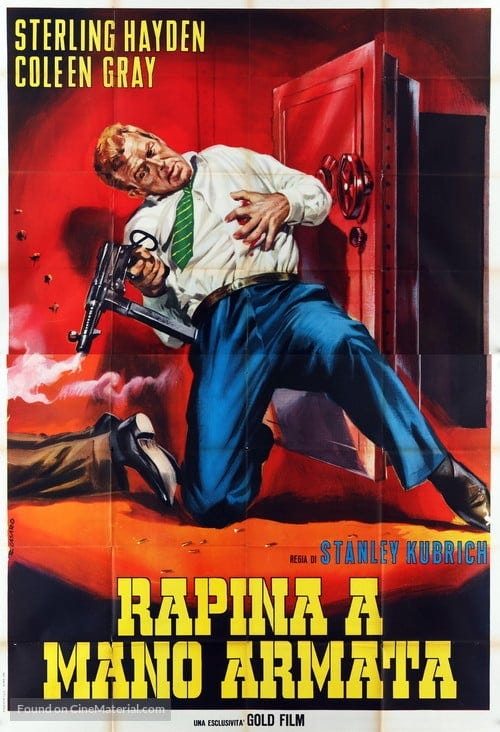
The Steal’s Poster of the Week
Want us to take a dive on a particular heist movie? Leave us a suggestion or two in the comments and feel free to let us know how we’re doing. We’d love to build THE STEAL around our readership, so come on board and help us course correct as we go.
Heist News
There is zero heist film news this week, presumably because nobody want to compete with CRIME 101. But if you want some IRL heist news then the BBC ran this long read on the huge robbery which happened in Germany over Christmas…
… Meanwhile, in Italy they’re busy recreating that scene from HEAT on the motorway.
Next Issue
Mike tackles another big one through every twist and turn in David Mamet’s HEIST (2001) with Hackman, DeNiro and enough smart dialogue for a plane/truck/boatload of caper movies. Great trailer too:
Thanks for reading. Thanks for subscribing. Thanks for sharing. Once the heat dies down we’ll see you at the prearranged location to split the take. What could possibly go wrong?
That’s one well parked jag! 😂